

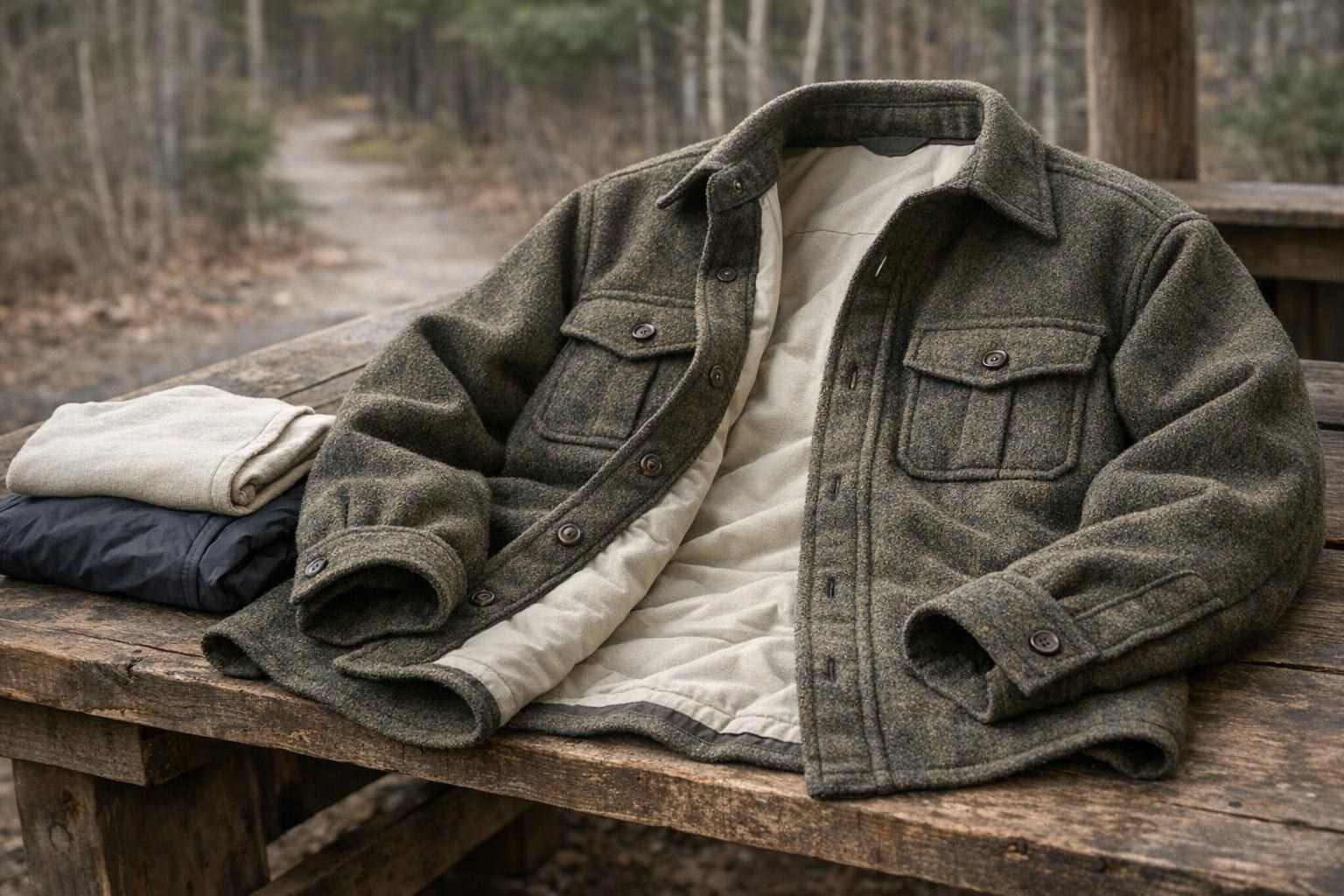
Outdoor wool clothing such as wool jackets and overshirts can be great for cool walks, for example for outdoor work during changing weather conditions. However, there are big differences between individual surplus wool items. Some may be near new, thick and of good quality while others are thin, misshapen and have suffered from long storage. Here we provide some simple checks on items of outdoor wool clothing to see if they might be of use to you. The simple checks are for fit, for condition, for warmth, for comfort and for how an item needs to be looked after. We provide guidance on choosing a garment for your needs and then provide simple checks for each of the above.
Match the garment to the way you go outside
The primary consideration is to choose a garment based upon the jobs you want to do and the activities you participate in, not based on the label. A heavy wool coat is perfectly suited for slow ambulation, camp chores, etc. However, for active hiking the heat trapped by the dense outer layer of wool will soon become a problem as will the resulting moisture. A lighter weight wool overshirt is more suitable for layering on and off for errands, travel, etc.
Exposure to weather also needs to be considered. A dense outer layer can offer some protection against wind but a dense layer of wool does not make a waterproof layer. Other weather layers i.e. shells will be needed for wet weather. Layers such as a wool overshirt are better for people who go in and out of buildings. They are easily carried when not needed and can be removed when too hot.
The only item of warmth which is of any use is that which you will wear. A very warm item which is stiff, too bulky, or which does not go with the rest of your clothing and cannot be carried, is of no use whatsoever.
Read the fabric before judging the style
Fibres: Lots of surplus wool clothing is made of fibre blends. While some blends improve durability, others just reduce price. Check the fibre content and the weave. Look for even surfaces, good quality seams and no thinning at elbows, cuffs, bottom of seat or collar.
Moths are attracted to wool. They can cause tiny holes, pin-holes or even big bare patches. Check for all types of damage. Also, check for a strong stale smell. Some garments may be okay after a good airing, others not. Try to find out how a garment has been stored. A musty smell can penetrate deep into the fabric, which may not come out in washing.
While the fiber content (and blend of fibers) is an important indicator of the garment's potential use, it is not the only factor to consider when purchasing surplus garments. Also, the weave of the fabric and the garment's construction can have a big impact on the garment's function and wearability.
Treat fit as a layering decision
A wool layer should have enough room for the clothing you wear underneath it, to prevent it from being pulled down by cold air. Try on the surplus wool garment with the base layer you intend to wear for it, then bend your arms, go for a dip and so on. If the garment pulls across your back, if it pulls at your armholes or if the collar of the garment pulls at your neck then it will soon become uncomfortable.
Sleeves will have cuffs which need to be long enough to cover the wrist when arms are raised but not so long as to get in the way of gloves when they are worn. When sitting down be aware how the hem will sit. A long hem may trail on the ground or even get caught up in various items of equipment. An oversize hem at the back of a coat can also be a nuisance when seated as it may trail on the ground behind you.
Sizing to wearing history must be determined by actual measurements of garment or compares to similar item already owned. Tag size is only an indicator.
Build warmth with layers, not one oversized coat
Wool layers are best when they have been chosen for specific purposes and combine well to provide the warmth that is needed. A good base layer will manage the moisture when it is next to the skin and help prevent the wearer from feeling clammy and cold. A layer such as a shirt, sweater or coat provides additional insulation and can be chosen from the items that have been purchased depending on the amount of warmth that is needed. The outer layer of the system will be a waterproof shell that can be worn when it is wet.
Again, just because something is warm on its own doesn't mean it's a good idea to layer a bunch of thick things on top of each other. As with any layering system, there must be room for air and for the arms to move. It's also good to remember that a vest can provide a lot of core warmth without the bulk of a sleeve. A lighter weight shirt can also provide a lot of warmth when layered on top of another insulating layer.
For active use such as walking outdoors consider a method to vent or remove a layer as warmth needs will change with pace of activity, wind and with entering into shade.
Inspect closures, linings and high-wear points
Notice the details of the fabric construction, too. In addition to tests of the fiber, check out the small stitches that connect the pockets, the shoulder, and the collar. All those things are going to wear out before the rest of the garment, and if you can replace a missing button or two before they start to come undone, all the better.
Check the lining (such as the pockets) for tears and worn places, check for any loose threads. Check for stickiness or flaking of interior material. If your item has any elastic, drawcords, hook-and-loop etc., check that these are functioning correctly too.
Consider whether a piece would feel comfortable to wear with your pockets empty, then with gloves, keys, etc. in them. In practical terms a deep recessed pocket with a flap or other closure would be superior to some of the other designs, but most surplus items will have straightforward pockets of some sort. Bulk is also important – a very bulky item is generally less comfortable than a less bulky one.
Wash and store wool with care
Many surplus wool garments have been carelessly washed and dried after purchase. It is really important to follow a care label if it has been provided, but many don't. If in doubt, it's far better to err on the side of caution and avoid any form of cleaning. Air the garment out and look for dirty areas that can be gently brushed clean. If the garment does require cleaning, check the fiber content and seek advice if necessary, particularly for lined or structured items.
Give your surplus woollen garments a good air before washing them. For slight soiling, brush them gently. When washing check the fiber content and ask for expert advice if garments are lined, have structured parts or are very dirty. Never dry uncertain wool garments in a hot dryer.
Store wool clothing items in a dry, well-ventilated place, fold heavier items instead of hanging them up in a narrow space. Check your clothing regularly for signs of insect infestation. Cedar and other storage items are available to assist in storing wool clothing but do not replace regular checks of clothing for signs of damage.
Use a simple buying checklist
Before choosing a piece, ask:
– Is the weight suitable for my pace and usual weather?
– Will it go over my normal base and mid layers?
– Are holes, odors, stains or thin areas acceptable to me?
– Are all closures (buttons, zippers, etc.) in good working order?
– Can I clean and store it without risking damage?
Military surplus clothing can make a very practical and unique addition to your wardrobe but remember, surplus does not always mean perfect. Inspect items before purchasing, ensure you have a purpose for the item and remember to allow for items such as wind and rain protection in your clothing system. This will help to turn a potentially cumbersome, warm item into practical clothing for everyday wear.